
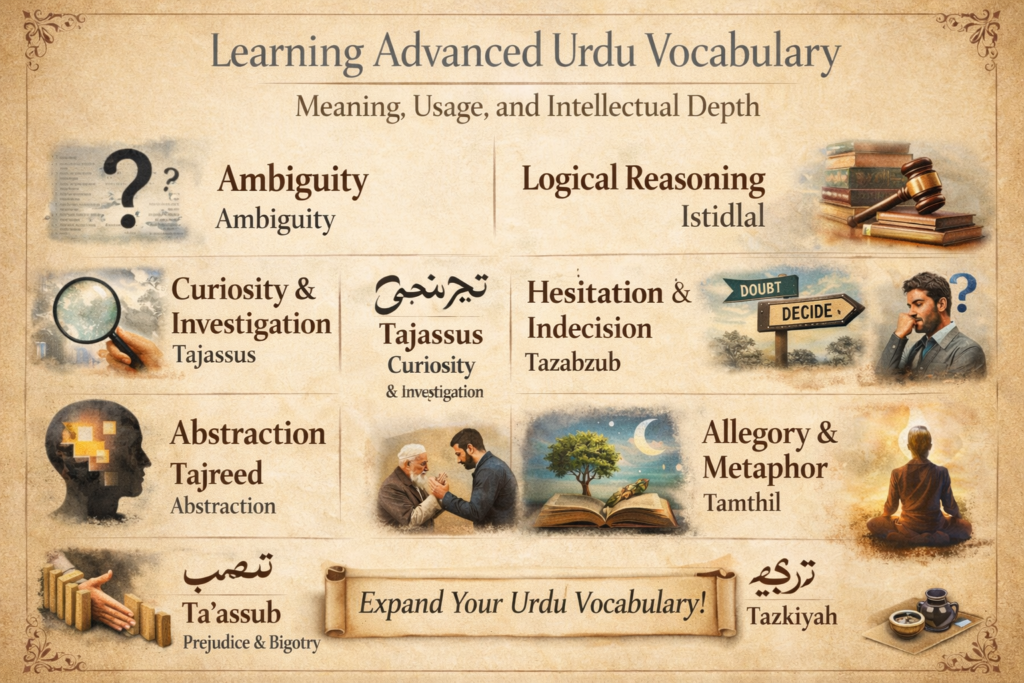
For learners of the Urdu language, vocabulary is not merely a collection of words but a gateway to deeper understanding of thought, culture, and expression. Advanced Urdu words often carry layered meanings rooted in philosophy, ethics, literature, and social life. Mastering such vocabulary enables learners to read classical texts, understand formal discourse, and express complex ideas with clarity and elegance. The following discussion explains selected advanced Urdu words and demonstrates how they enrich language learning.
Understanding Meaning through Clarity and Reasoning
Many Urdu learners initially struggle with ابہام (ambiguity), where a word or sentence may have more than one meaning. Recognizing ambiguity is essential because it teaches learners to look beyond literal translation and understand context. To overcome ambiguity, learners must develop استدلال (logical reasoning). Reasoning helps students analyze sentence structure, infer meaning, and interpret subtle nuances, especially in poetry, essays, and philosophical texts.
Curiosity and the Learning Process
Language learning begins with تجسّس (curiosity)—the desire to know new words, their origins, and their correct usage. Curiosity motivates learners to explore dictionaries, literature, and spoken contexts. However, learners often experience تذبذب (hesitation) while speaking or writing, especially when unsure about pronunciation or grammar. This hesitation is a natural part of learning and should be seen as a step toward linguistic confidence rather than a failure.
Abstract Vocabulary and Explanation
Urdu contains many تجریدی (abstract) words that do not refer to physical objects but to ideas, emotions, or states of mind. تجرید (abstraction) allows learners to express complex concepts such as morality, philosophy, and emotion. To truly master such words, تفہیم (explanation) is essential. Teachers, textbooks, and learners themselves must explain words through examples, contexts, and comparisons to ensure accurate understanding.
Respectful Language and Expression
Urdu is known for its polite and refined tone. Words like توقیر (respect) and تمکنت (dignity and composure) are central to formal speech and writing. Learning these words helps students understand how language reflects social values. Using respectful vocabulary correctly allows learners to communicate appropriately in academic writing, official correspondence, and literary expression.
Continuity and Critical Learning
Vocabulary learning requires تسلسل (continuity)—regular reading, revision, and practice. Consistent exposure to words reinforces memory and improves fluency. At the same time, learners must practice تشکیک (critical doubt) by questioning meanings, checking usage, and verifying interpretations rather than accepting translations blindly. This approach leads to deeper and more accurate language mastery.
Avoiding Bias and Understanding Cultural Sensitivity
Some advanced Urdu words express social attitudes, such as تعصّب (prejudice). Understanding such words helps learners grasp social criticism in literature and media. Similarly, words related to تقدیس (sanctity or holiness) are common in religious, moral, and poetic texts. Learners must understand the cultural and emotional weight of these words to use them respectfully and accurately.
Awareness, Individuality, and Language Growth
Language learners sometimes practice تغافل (deliberate ignorance) by avoiding difficult words or complex structures. Overcoming this tendency is crucial for progress. Developing تفرّد (individuality) in language use allows learners to form their own style of expression while respecting grammatical and cultural norms. Individual voice is especially important in essay writing, debates, and creative work.
Metaphor and Emotional Expression
Urdu literature frequently employs تمثیل (metaphor and allegory) to convey deep meanings indirectly. Learning such vocabulary enables students to appreciate poetry and prose beyond surface meaning. Encountering rich metaphorical language often produces تحیر (astonishment), a sense of wonder that inspires learners to continue exploring the language’s literary beauty.
Authentic Language Use and Refinement
Learners should be cautious of تکلف (artificiality or excessive formality) in speech and writing. While Urdu values politeness, overuse of complex words without understanding can sound unnatural. Authentic learning involves using vocabulary naturally and appropriately. Understanding historical terms like تسخیر (conquest or domination) also helps learners comprehend historical narratives and classical texts.
Progress through Balance and Self-Improvement
Language learning involves emotional and intellectual تموّج (fluctuation)—periods of rapid progress and moments of difficulty. Recognizing this helps learners stay motivated. Ultimately, mastering vocabulary requires تزکیہ (self-purification and refinement) in a linguistic sense: removing incorrect usage, refining pronunciation, and improving clarity of expression through continuous practice.
Conclusion
For learners of Urdu, advanced vocabulary opens the door to deeper comprehension, refined expression, and cultural understanding. Words are not isolated units but carriers of history, thought, and emotion. By approaching vocabulary with curiosity, continuity, critical thinking, and sincerity, learners can transform Urdu from a subject of study into a powerful medium of expression and intellectual growth.